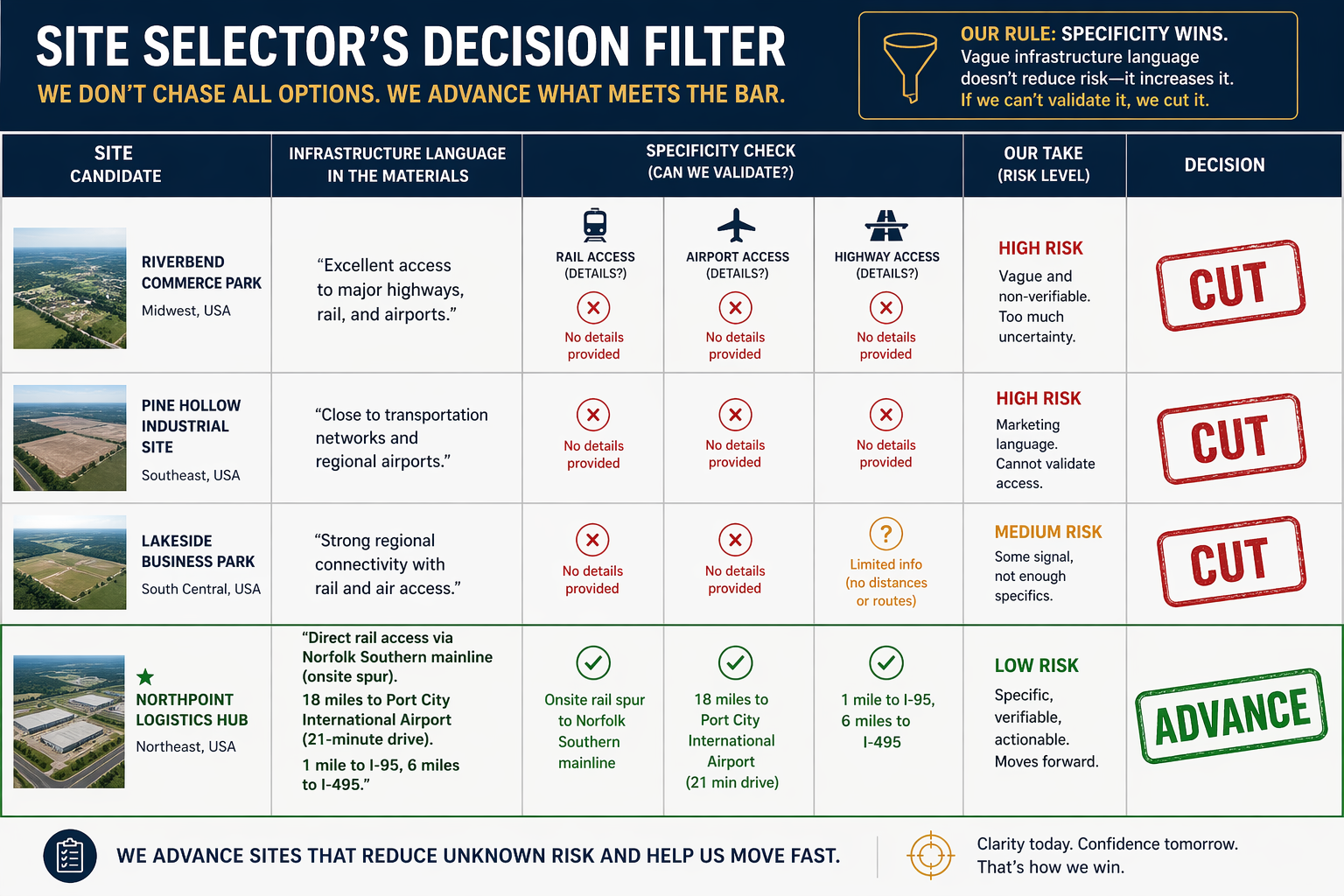
Industrial site marketing is full of phrases that sound useful but do not hold up under scrutiny. “Near rail.” “Close to airport.” They show up everywhere, and they mean almost nothing unless you define them.
Site selectors do not read listings like marketing copy. They read them like filters. If something is vague, it slows them down or gets your site cut early.
As one site selector put it:
“Good sites do not hide behind vague language. The best ones tell me exactly what I can and cannot do on day one.”
Let’s tighten this up.
Rail: What “Near” Actually Means
When a project says it needs rail, it usually means one thing: it needs to put railcars on the property.
Here is how distance really breaks down:
- Rail-served: Rail spur already on-site.
- Rail adjacent: The line touches or nearly touches the property. A spur could likely be built.
- Near rail: Roughly within 0.25 to 1 mile, and physically buildable.
- Marketing “near rail”: 1 to 5 miles away, with no realistic spur.
- Not rail-relevant: Beyond about 5 miles.
Most experienced selectors are skeptical of the phrase altogether:
“If I see ‘near rail,’ I assume there’s no rail until proven otherwise. If it matters, just tell me if I can get a spur onto the site.”
What actually matters:
- Can a spur be built?
- Who serves the line, such as Union Pacific Railroad or BNSF Railway?
- What is the service level?
- Is there a viable transload option?
If you cannot reasonably get track to the site, it is not “near rail” in any meaningful sense.
Airports: Proximity vs. Usefulness
Airports are similar, but the use case is different. Most industrial users do not need to be on the runway. They need fast, reliable access to cargo operations.
Here is how that breaks down:
- On-airport / cargo park: Direct access to cargo terminals.
- Adjacent: Within about a mile.
- Near airport: 1 to 5 miles, typically a 5 to 15 minute drive.
- Regional access: 5 to 15 miles.
- Not a factor: 15+ miles.
The issue is that “near airport” gets stretched beyond usefulness:
“Most of the time, ‘near airport’ just means it’s somewhere in the same metro. What I need to know is how fast a truck can get to the cargo terminal.”
For example, proximity to George Bush Intercontinental Airport only matters if trucks can reach cargo operations quickly. A site farther away with clean highway access often beats one closer with congestion.
What actually matters:
- Access to cargo terminals, not just the airport boundary
- Drive time, not miles
- Highway connectivity
- Flight frequency and cutoff times
If it is not within about 15 minutes of cargo operations, it is not meaningfully “near airport” for logistics.
Why This Matters
Most RFIs are built to eliminate sites quickly. Ambiguity works against you.
When you say “near rail” or “close to airport,” a selector has to interpret. Or worse, assume the answer is no.
Clear language speeds up decisions and attracts the right projects.
Say This Instead
Skip vague phrasing and use specifics:
- “Rail spur on-site served by Union Pacific Railroad”
- “0.4 miles to active rail line; spur feasible”
- “No rail access; 6 miles to transload facility”
- “3 miles (8-minute drive) to George Bush Intercontinental Airport cargo terminal”
- “18 minutes to air cargo with direct highway access”
The Rule
If the infrastructure cannot be used, distance does not matter.
Rail must be buildable or on-site. Airports must be reachable quickly at the cargo level.
Everything else is just marketing language.