In a recent conversation on the Econ Dev Show, something small but revealing happened.
Ellie Reynolds, President and CEO of the Douglas County Economic Development Corporation, talked proudly about how quickly projects can move in her community. Six months or less from start to finish. In Colorado, that’s fast. In many places, it’s best-in-class.
Then a site selector responded:
“That’s great. I can get permits in Texas in four weeks.”
That moment exposed the reality in economic development: speed to market beats incentives, almost every time.
Why Speed Matters More Than Ever
Capital is more mobile than ever. Projects are under pressure from interest rates, construction costs, supply chains, and internal corporate timelines that don’t care about local process.
When timelines stretch, risk increases. When risk increases, projects die quietly.
Every community wants to lead with incentives, workforce, and quality of life. Those matter. But none of it matters if a company can’t get a straight answer fast enough to keep the project alive.
Time is the one incentive every community controls.
What Douglas County Gets Right
Douglas County understands something many communities are still missing: speed doesn’t start at the permit counter.
It starts years earlier.
They invest in infrastructure ahead of demand. Roads, utilities, wastewater, and transportation corridors are in place before rooftops and projects arrive. That’s how shovel-ready sites are actually created, not declared.
They participate directly in planning, transportation, and growth conversations so economic development isn’t reacting after decisions are made. And when state-level regulation becomes a constraint, they focus relentlessly on what they can control locally: timelines, coordination, and clarity.
That mindset reframes economic development as risk reduction, not growth-for-growth’s-sake.
The Real Cause of Delays
Here’s the part most of us don’t want to admit.
Projects don’t slow down because of incentives.
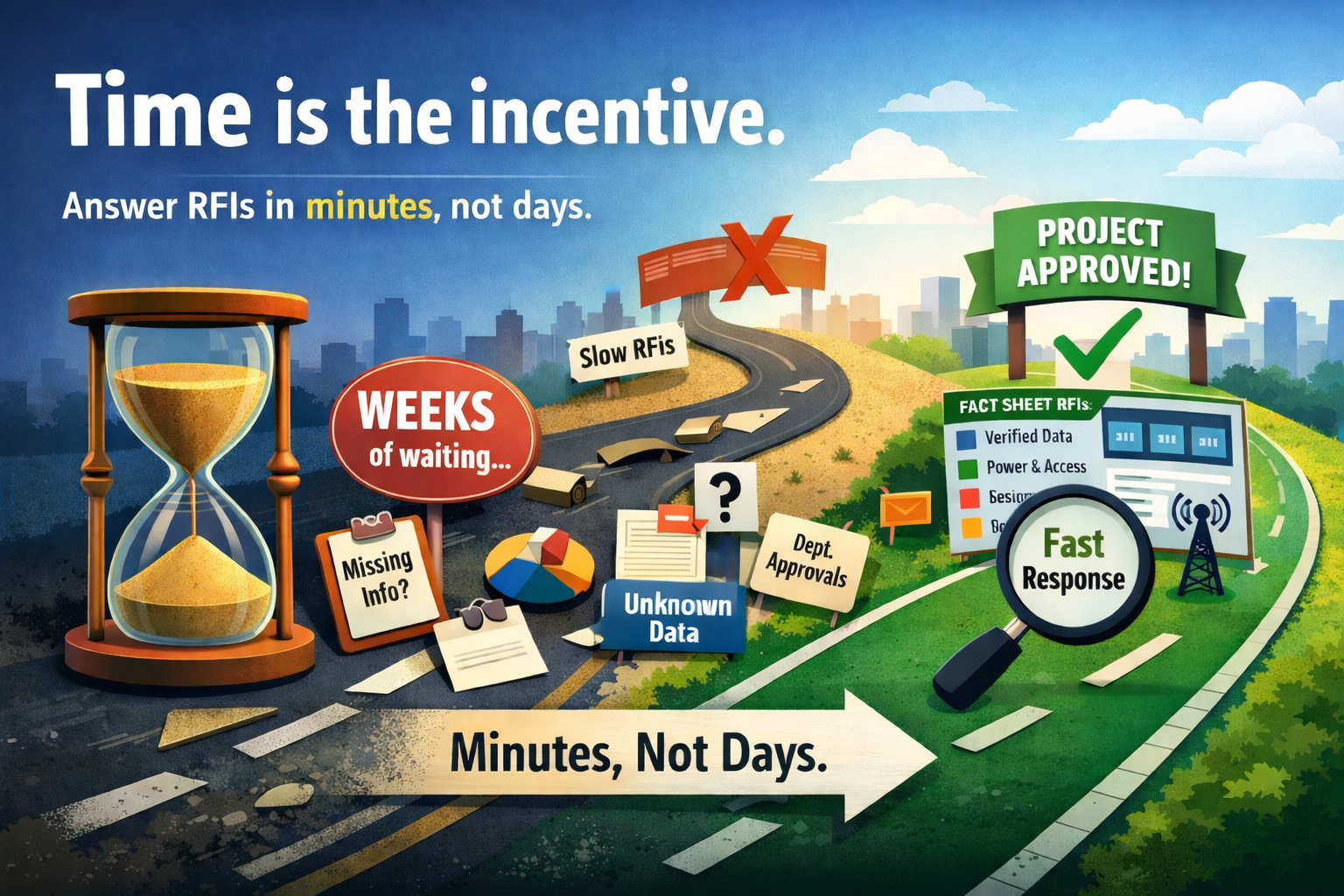
They slow down because of information.
RFIs drag on because:
- Data lives in too many places
- Answers depend on three departments and two spreadsheets
- “We think” replaces “we know”
- Nobody wants to say “unknown” out loud
By the time an answer is assembled, the site selector has already moved on. A power-capacity confirmation that takes nine days might as well be a no.
Speed to market isn’t just permitting. It’s how fast you can answer the first question.
Speed Starts Before the Permit
Before a company ever files paperwork, they want to know:
- Is there power, and how much?
- What’s the real broadband situation?
- How close is this site to the airport, the workforce, the suppliers?
- Is zoning theoretically allowed or practically viable?
- What’s known, what’s estimated, and what’s unknown?
If those answers take days or weeks, you’re already behind. Not because you’re unwelcoming. Because the process can’t keep up with modern site selection.
Where Sitehunt Fits
This is exactly the problem Sitehunt was built to solve.
Sitehunt is about pre-permit speed. It pulls together scattered data, fills in gaps with educated estimates, and clearly labels what’s verified, what’s inferred, and what’s unknown. That happens through the Property Database and RFI Automation.
What used to take days of internal research can now happen in minutes. Not because economic developers don’t know their communities, but because knowing something and proving it fast are two different things.
Sitehunt helps economic developers respond at the speed site selectors now expect.
Speed Is a Mindset, Not a Metric
Douglas County’s story isn’t just about cutting red tape. It’s about deciding that time matters, then backing that belief with infrastructure, process, and tools.
- You may not control state policy.
- You may not control incentives.
- You do control how fast you answer.
The communities that win aren’t always the cheapest or the biggest. They’re the ones that reduce friction first.
The Question Worth Asking
Every economic development organization should ask one simple question:
How fast can we answer the first RFI?
Because speed to market doesn’t start at permitting.
It starts the moment someone asks, “Can this site actually work?”
That’s the race now.